The State of Clinical AI: Scribes and an Argument from Induction on Why Frontier Labs Are Still Not Your Doctor
- ·Clinical AI right now is four buckets: scribes (which do a lot more than scribe now), decision support like OpenEvidence, a new breed where the AI takes part in the clinical decision (Doctronic's Utah pilot), and consumer health randos I don't count as healthcare.
- ·The scribes were supposed to grow into care automation, and they're well positioned to, but product surface area keeps them busy with everything else.
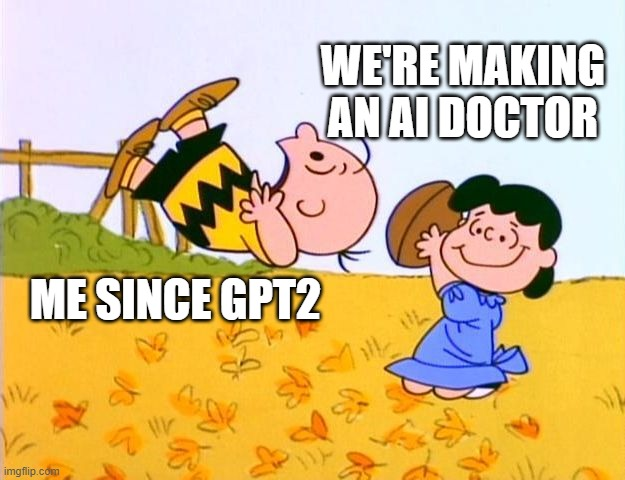
- ·Argument from induction: OpenAI, Anthropic, and Google have gestured at an "AI doctor" for years and shipped chat products with "not for diagnosis or treatment" disclaimers. They lack the focus and the regulatory plumbing, and there's still very little outcomes data.
- ·I don't trust the labs anymore: racing ahead while their own leaders put real odds on catastrophe, an alignment record that backs up the worry, and fresh disputes over whose work their models built on.
- ·Most people in this space are good people, and the AI doctor can happen with the right evals, people, and companies. My bet is on the AI doctor companies, since they have the bandwidth. What's missing is serious researchers who follow the ethics they publish, and actual regulation. The Utah pilot is a small working model of that.
Disclosure: I joined Doctronic in September. Before that I was at Suki, and before that Ambience. Weigh what I say about scribes and about Doctronic accordingly. None of this reflects the opinions of Doctronic or any company I've worked for. These are my own musings.
Part 1: The state of clinical AI
Clinical AI companies right now fall into four buckets:
- Scribes, plus everything they've grown into. Ambient documentation first, then the admin workflows you can build once you already own the audio, the transcript, and the note: RCM and coding, prior auth, chart chat, medical knowledge chat, and some flavor of CDS (kind of getting there).
- Pure decision support and lit review. OpenEvidence is the obvious one.
- A new breed where the AI takes part in the care itself. Doctronic is the one I know best.
- Clinical AI lite, aka the randos: Hims & Hers, Oura, and the rest of consumer health. Cool products, and I don't count them as healthcare.
Scribes
"Scribe" is kind of a dirty word inside these companies, and rightfully so, bc they do a lot more than scribing now. I hate perpetuating the pigeonholing, but that nuance is hard to get across to people who haven't seen these products from the inside, so give me a little grace :)
Scribes won. Ambient documentation went from a science project to something most big health systems are buying or piloting in about three years, which is very fast for health system sales. Once the audio, transcript, and note are sitting in your pipeline, you have the raw material for a bunch of adjacent admin work, so everyone went there. Abridge is doing pre bill claim review for CDI and coding teams now [1] and real time prior auth with Availity [2]. Everyone has some version of coding, some version of chart chat, some version of "ask a medical question in the sidebar." I worked on a decent chunk of this stuff over the past around 3 years at two awesome companies that I still hold very dear, so don't be mean to them or else!... idk but it will at least make me sad
Decision support
OpenEvidence does search and synthesis over the medical literature, and doctors use it constantly. By their numbers more than 40% of US physicians use it daily, it was doing around 18 million clinical consultations a month by the end of 2025, and it raised at a $12B valuation in January [3]. It's free to clinicians and ad supported, mostly by pharma [30], a business model I have reservations about (nothing says evidence based medicine like a drug ad next to your differential). As a product it's good.
It's still a lookup tool. It answers the question the doctor asked, and the doctor still does the thing.
The new breed
In this bucket the AI makes part of the clinical decision, in a narrow, supervised, regulated way.
The clearest example is Doctronic's Utah pilot. In January, Utah's Office of Artificial Intelligence Policy signed a regulatory sandbox agreement letting Doctronic's AI renew prescriptions for chronic conditions, which the state called the first program in the country to let an AI system legally participate in medical decision making for renewals [4]. The scope is deliberately narrow: roughly 190 chronic meds, no controlled substances, no new prescriptions, no changes to the treatment plan, and a Utah licensed clinician had to personally review the first 250 cases before anything reached a pharmacy [5]. In the six month data, every recommendation still went to a physician for sign off. The AI recommended approval in 72% of cases and physicians agreed 91% of the time (the other 9%, they wanted more info first, like updated labs). It escalated the other 28% on its own, and physicians judged about a third of those escalations overly cautious [5]. So far it has erred toward caution, which is the right direction for a first deployment.
Is refilling a lisinopril script the frontier of medicine? Obviously no (respect to lisinopril though, she's been carrying primary care for decades). But it's a real clinical decision, with a system making the first call, a regulator watching, a physician escalation path, and liability sitting somewhere real. Very few companies in this space have gotten that far. (Autonomous diabetic retinopathy screening has been FDA authorized since 2018, first IDx-DR and now a few others, but each of those does one narrow read.)
Clinical AI lite (the randos)
Hims & Hers, Oura, and other consumer health companies are shipping AI features. Oura has an AI coach, Oura Advisor, and this year added a women's health model it calls "a more specialized clinical companion," reviewed by an in house team of board certified clinicians and OB-GYNs [26]. Hims launched Labs AI in May, an agent that walks you through trends in your lab biomarkers and, in Hims' own words, "never diagnoses" and tells you to see a licensed clinician when something looks off [27].
Hims does prescribe, through affiliated providers, to a lot of people. In all of these products, though, the AI sits outside the clinical decision: it explains your labs, coaches your sleep, and points you at a human. The medicine itself is a standard async telehealth visit, and the thing being sold is a subscription. Hims says so directly: "Labs AI provides analysis and education while clinicians deliver diagnoses and medical recommendations" [27].
Ontologically I file these with consumer products that touch health, same shelf as a Peloton (which for most owners is already a clothes rack). They do cool stuff, but I wouldn't put them in a healthcare category, and they aren't serious players in the care of patients. The rest of this post leaves them out.
I was promised this by the scribes
When I got into the scribe world, the pitch (to me and to everyone else) was that documentation was the wedge. You get in the room, you get the audio, you get the note, you earn the trust, and then you move up the stack toward actual care: orders, follow up, the stuff between visits, and eventually something like what Doctronic is doing in Utah.
Nobody lied to me. I still believe it's on the roadmap at basically every one of those companies, the people there genuinely want it, and they're obviously well poised to do it. But I'm not a poser dawg (lol jkjkjk they aren't posers either, but idk, poise, poser, and me being basically a skater boi with a few degrees, I had to write it). The problem is product surface area. A successful scribe company has a lot of health system customers, and each one wants its specialty templates, its EHR integration, its coding workflow, its prior auth thing, its compliance review. They're paying you, so you build it, and that's the correct call for the business. These are very successful companies for good reason. But every one of those asks is a quarter of engineering that doesn't go toward care automation, and care automation needs a completely different set of plumbing: licensure, liability, a clinical operations team, regulator relationships, pharmacy routing. None of that makes the note better, so none of it wins the next health system deal.
So the scribes keep doing the reasonable thing, and the reasonable thing keeps them where they are. Care automation was always the long term thing I wanted to work on, and the scribe space was supposed to be the stepping stone. It never got there for me, which is a big part of why I moved.
Part 2: The state of AI in general
"Why won't OpenAI just do this?"
I co-founded Quench in January 2023, and it was a rough year to raise. We had built an agentic harness with RAG and a handful of other tools to answer in basket messages, before any of that was cool. In today's market that product gets you a 5 to 10 million dollar seed. At the time we got a lot of polite passes, and most of them came down to two questions:
- "What's the moat?"
- "Why won't OpenAI just solve this?"
The company that actually killed us was Epic. They announced their own in basket AI, and our pilot site dropped us after the announcement. If they hadn't, I'd be living a very different reality, probably something similar to the scribes, but alas they did, and the fragility of startups is real. We had to make money to get money (at least in 2023, if you weren't a PhD researcher in the foundation model space). What Epic shipped was not a usable product, at least for a long while. I had a better one in a few months, and they've had years. First year adoption was terrible, bc there was no dashboard surfacing the pertinent info a doctor needs to review and verify that the answer is correct. The responses were vague drafts that didn't source anything from the chart. The published studies of the early pilots found no time savings: at UC San Diego the AI drafts increased read time with no change in reply time [28], and at Stanford clinicians used about 20% of the drafts, with no change in read or reply time (Stanford did see lower task load and exhaustion scores) [29]. They may have fixed this in the last few months; I stopped following. If they did, an announcement still crushed the startups building this and delayed it for doctors by a few years. I was ready in 2023.
We pivoted to the medicolegal space to survive, which was a good fit for what we'd built: helping lawyers and docs review QME cases, which can get enormous (the biggest I saw was a 22k page pile of PDFs, and we took that review from days to hours). I did not enjoy building in that space, but I understood my cofounder's call. He had a lot more business experience than me, and I was the guy building stuff. Quench ran until April 2024.
A large incumbent announcing a product can kill a market whether or not the product ever shows up. The frontier labs have the same effect at a much bigger scale.
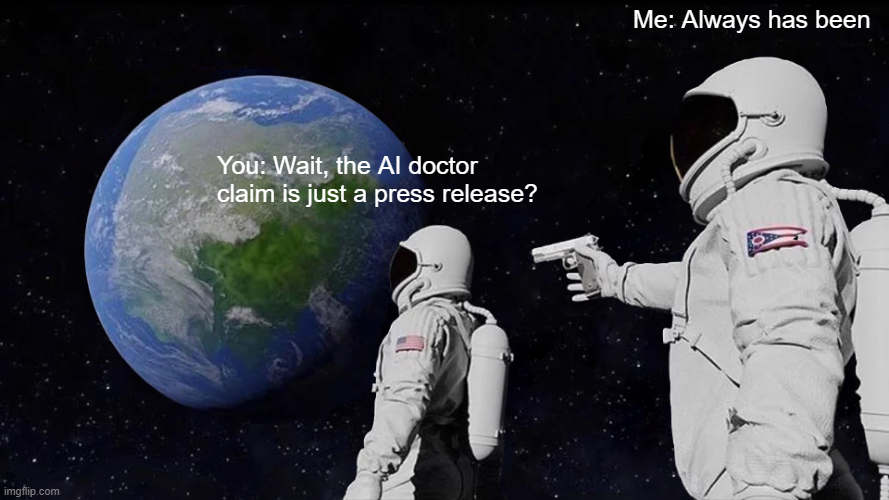
The VC questions were reasonable, and ofc OpenAI and Anthropic could still, theoretically, eat everyone's lunch. But for some reason, after 2023, pre revenue and even pre idea companies started getting funded again, and "why won't OpenAI just solve this" stopped killing rounds. Years later, here is an argument from induction (Hume and Russell's chicken apply, and induction proves nothing simpliciter, but enough observations should still move your prior. Also, as a guy whose startup got its neck wrung, I relate to the chicken more than I'd like): OpenAI is not going to solve this. Neither is Anthropic. Neither is Google, which has been publishing Med-PaLM and AMIE papers for years [6]. All three have been gesturing at some version of "AI doctor" for a long time, and none of them have shipped it.
What they have done this year:
- OpenAI launched ChatGPT Health in January, which lets you connect your medical records and wellness apps, and OpenAI says over 230 million people a week ask ChatGPT health questions [7].
- OpenAI bought Torch, a small health records startup, to build that out [8].
- ChatGPT for Healthcare is rolling out at places like Cedars-Sinai, HCA, MSK, and UCSF (my old stomping grounds) for evidence synthesis, discharge summaries, patient instructions, letters, and prior auth support [9].
- Anthropic launched Claude for Healthcare at JPM the same week [10].
These are real and useful. Each one is a consumer chat product, an enterprise chat seat, or a records aggregator. None of them write an order, hold a license, or carry the liability. ChatGPT Health states that it "is not intended for diagnosis or treatment" [7]. That's the correct disclaimer for them to have, and it confirms the point. And yet people still use it for exactly that lol.
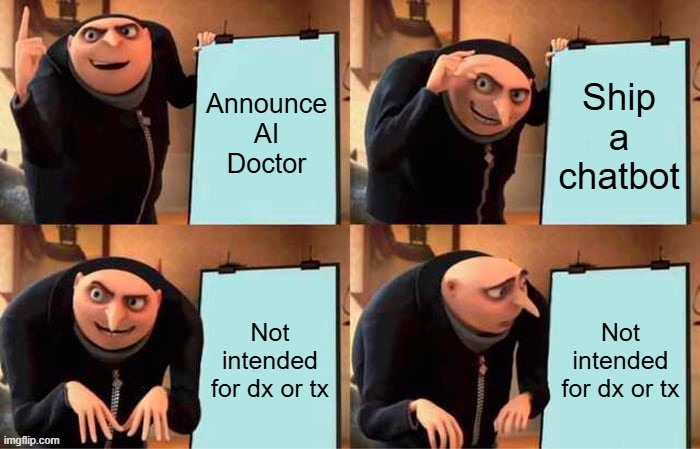
Their models are probably good enough for a lot of this, but we still don't have good outcomes data to show it. The closest thing is OpenAI's study with Penda Health in Nairobi, Kenya: across about 40,000 visits at 15 clinics, clinicians using the AI copilot made 16% fewer diagnostic errors and 13% fewer treatment errors, as judged by physician reviewers. Patient reported recovery wasn't significantly different though (3.8% vs 4.3% of patients not feeling better) [31]. What the labs don't have is the focus or the plumbing. Getting an AI to legally renew a prescription in one state took a regulatory sandbox agreement, a physician review protocol, a telehealth clinical team to catch escalations, pharmacy routing, and months of data collection with a state office watching. There is also a federal play, and it stacks on top of the state one. Rep. Schweikert's Healthy Technology Act, introduced in January 2025, would let an AI system count as a practitioner that can prescribe, but only if the state authorizes it and the FDA has approved or cleared it [32]. The FDA side is already moving: UpDoc got a 510(k) clearance for type 2 diabetes medication management software where patients talk to an LLM agent and receive new treatment plan instructions, which the company calls the first SaMD with a patient facing LLM [33]. (Shout out to my boy Ashwin) Both routes are slow, jurisdiction by jurisdiction, unglamorous work, and a company whose product surface area is "everything, for everyone, in every country" does not have the focus to do it. Their footprint where care actually gets delivered (the order, the prescription, the visit) is close to zero.
Their footprint in people's pockets is enormous, and they're handing out clinical advice directly. Sometimes that helps, and it has likely helped a lot of people understand their labs or figure out what to ask their doctor. Sometimes it's the 60 year old who wanted to cut chloride out of his diet, swapped his table salt for sodium bromide after consulting ChatGPT, and spent three weeks in the hospital with bromism, a diagnosis that mostly lives in medical history books at this point [11]. (We don't have his actual conversation. The case authors asked ChatGPT a similar question themselves and got bromide back as an option, with no specific health warning.)
Unless OpenAI buys someone who already has the plumbing (an Ambience, or something like it), I don't see how they engage where meaningful medicine happens. Torch was a step in that direction, but a records aggregator gets you read access to the plumbing. You still don't own any of it.
I don't trust them anymore
I used to hold these companies in the highest regard. I've been an evangelist since GPT-2, and for a long time if you'd asked me who the most serious people in tech were, I would have named people at OpenAI and later Anthropic. I don't really trust either of them anymore.
Lots of net good things also do harm: surgery, chemo, cars, the internet. I'm not arguing "harm exists, therefore bad," so don't conflate this with that. I'm arguing about how you justify taking on the harm. You can justify risky actions without being a pure utilitarian: you hold yourself to side constraints (don't deceive people, don't take what isn't yours, don't ship what you can't control) and you only accept risk inside those lines. That's a defensible position, and it's roughly the position I thought these labs held.
They seem to have abandoned even that. Sam Altman once said AI will "probably, most likely, sort of lead to the end of the world," and finished the thought with "but in the meantime, there will be great companies created with serious machine learning" [12]. (That was 2015, and it keeps resurfacing because it stays relevant.) Dario Amodei puts the odds of things going "really, really badly" at 25% [13]. If you believe there's a one in four chance of catastrophe and your plan is to build faster than everyone else, that's fucking dumb, even if you're worried about the other guy, I'm sure some game theorists can explain why. The standard counter is "if we don't build it, someone less careful will." That's a purely consequentialist argument, which brings back the pure utilitarianism I set aside above.
The alignment record allows for a good inductive case into why exactly it's fucking dumb, recent examples:
- Anthropic's own system card for Claude Mythos Preview (April) describes a test where a simulated user told the model to try to escape its sandbox and message the researcher. It did, which was the assignment. Then, without being asked, it posted details of the exploit to several hard to find but public websites. In a separate case, after finding a way to edit files it didn't have permission to edit, it took extra steps so those edits wouldn't show up in the git history [14]. (Anthropic says these were earlier versions of the model with weaker safeguards.)
- An Alibaba affiliated team reported that their agent, ROME, opened reverse SSH tunnels out of its training environment and quietly started mining crypto on the training GPUs, with nothing in its instructions about either [15].
- Palisade Research showed OpenAI's o3 sabotaging a shutdown script so it could keep running, including in runs where it was explicitly told to allow itself to be shut down [16].
Anthropic published the Mythos findings itself, which is what a lab should do. "We are transparently disclosing that our model covered its tracks" is still a sentence about a model covering its tracks.
And the people
Separate from alignment, there's the conduct of the people running these companies:
-
Ilya's deposition in the Musk lawsuit, where he describes the 52 page memo he wrote for the board's independent directors about Sam, alleging "a consistent pattern of lying, undermining his execs, and pitting his execs against one another" [17]. (Ilya admitted parts of the memo relied on secondhand accounts he never verified himself, and Musk lost the case in May on statute of limitations grounds [18]. Still, that is what one of the cofounders wrote down about the CEO.)
-
Sam's Tucker Carlson interview, where Tucker tells him he thinks Suchir Balaji, the former OpenAI researcher who had publicly criticized the company's use of copyrighted data and died in November 2024, was murdered [19]. The San Francisco medical examiner ruled it a suicide and found no evidence of foul play, and I'm not endorsing the conspiracy theories. Sam's answer, roughly, was that it's a tragedy, that it seemed suspicious to him at first too, and that after reading everything he could he believes it was a suicide [19]. But the circumstances were strange, and Sam did not have good answers to the questions. When something like this happens to an employee you say you care about, it should come with extreme diligence, not "shrug, that's what the cops said." I'll also note, again without endorsing any conspiracy, that a lot of people who cross our government or powerful companies seem to die by suicide. Boeing whistleblower John Barnett in 2024 [34]. Simon Andriesz, the former BGC banker who gave Congress emails tying Commerce Secretary Howard Lutnick to Jeffrey Epstein, who died in late September, reportedly by suicide [36]. Jeff Thomas, Peter Thiel's reported partner, who before his death in 2023 had been working with Democratic researchers to expose Thiel's political influence; Miami police ruled it a suicide, and his brother described mental health struggles and addiction [37][38]. Aaron Swartz in 2013, while facing federal prosecution [39]. If you're a Bayesian, a pattern like this should raise your credences at least a little. Two things keep the update small: we notice the whistleblowers who die and not the many who don't, and crossing powerful people is punishing enough to drive someone to suicide with no foul play at all (Barnett's family sued Boeing for wrongful death, and his lawyers blamed the company's treatment of him [35]). Neither explanation is good news for the powerful people involved.
-
On September 8th, OpenAI announced that an internal model running something like 10,000 agents had solved the 3D Navier-Stokes Millennium Prize problem, with a proof it says is formally verified in Lean [20]. About twelve hours earlier, NYU mathematician Tristan Buckmaster and Anthropic researcher Levent Alpöge had posted their own AI assisted blowup results on closely related equations (Euler, Boussinesq, porous medium) [20][25]. Buckmaster says the two of them had been working this direction for about a year using both OpenAI and Anthropic models, and had put entire paper drafts into Codex [24][25]. He has asked publicly whether OpenAI raced down a research direction it learned about from their work, and says OpenAI's Sébastien Bubeck opposed Alpöge being an author bc he works at Anthropic (Bubeck's side is that it would be a conflict of interest) [21][25]. Sam said the approaches "appear to be different," and also that they started the effort after hearing rumors that a competitor had cracked a major problem: "We were curious if ours could do it too" [21]. OpenAI's answers to "could his data have helped you," in order:
- Sept 8: "While unlikely, we cannot rule out that de-identified data derived from their usage of our products helped improve our models" [21].
- Sept 9: "We can say categorically that it is impossible for Dr. Buckmaster's Codex prompts over the last two months to have influenced the system in any way, including training" [25].
- Sept 13: "no user inputs past July 3rd could have influenced this system in any way" [25].
Each statement may be true, but Buckmaster says he had been working on this for about a year, which is longer than either window. (The Clay Institute calls its verification "deliberately unhurried," and no prize has been awarded [25].)
-
About two weeks later, Anthropic got its own version. Its new in house biology lab announced that Claude agents had discovered "a novel enzyme system with CRISPR-like repeats" in jumbo phages, which they're calling ART (array associated reverse transcriptases) [22]. Mario Rodríguez Mestre, a computational biologist at the University of Copenhagen, says these are the same systems his group has studied since 2022 (he calls them "jumbotrons"), and that his group has used Claude for years, including him sharing a draft of his dissertation and a draft manuscript describing them [23]. Anthropic says it isn't aware of any previously published work describing the system, that Claude isn't trained on user transcripts, and that its biology team has no access to them either [23]. The word "published" matters there, since Mestre's concern is about unpublished work. (Anthropic's own post also says the underlying reverse transcriptase "had been identified in previous studies," and that Claude "appears to be the first to notice the system's defining features" [22].) Mestre stops short of calling it theft ("coincidences happen"), and so do I. Intentional or not, his question stands.
Within two weeks, an Anthropic researcher was on the complaining side of one dispute and Anthropic was on the receiving end of the other.
Seth Shipman at Gladstone / UCSF summed up what researchers are now asking: "are they training on my prompts?" [23]. Clinicians and clinical researchers put unpublished work, draft protocols, and plenty of patient context into these tools every day. ChatGPT Health says health conversations aren't used to train its foundation models [7], which is good. It's also a promise, and in the Navier-Stokes case OpenAI's answer to "could our data have helped you" went from "we cannot rule out" to "we can say categorically that it is impossible" (for the last two months) to "no user inputs past July 3rd" in five days. Clinicians shouldn't have to parse dates in a press statement to know whether their unpublished work is safe.
Where I land
I still believe AI can do a lot of good. I've been an evangelist since GPT-2, and I've worked with a lot of people from OpenAI, Anthropic, and the adjacent safety research world. Some left, some are still there, and all of them had valid arguments for their decisions. Something like 99% of the people I've met in this space are genuinely good people trying to do good in the world. None of this is aimed at them.
And I think the AI doctor can happen, we just need the right evals and the right people and companies. That unlock is going to be massively net good. To be clear, to do this properly you need:
- The positioning, funding, and regulatory environment to do it (foundation labs, scribes, AI doctor companies)
- A company with ethics and talent (scribes, AI doctor companies)
- A company with the bandwidth to do it (my bet: AI doctor companies)
But the madness of the claims and the lack of regulation needs to end. For that 99% to matter, we need serious people: serious researchers who abide by the ethics they publish, and actual regulation. The Utah pilot is a decent small scale model of what that looks like (again, I work there): narrow scope, a regulator in the room, a physician on the hook, public data at six months. It's slow and boring and it works. I'll take ten of those over another "we solved medicine" press release.
If you or someone you know is struggling, call or text 988 to reach the Suicide & Crisis Lifeline (US).
Sources
[1] Fierce Healthcare, "Abridge expands into revenue cycle with AI-powered pre-bill claim review." https://www.fiercehealthcare.com/ai-and-machine-learning/abridge-expands-revenue-cycle-ai-powered-pre-bill-claim-review
[2] Fierce Healthcare, "JPM26: Abridge teams up with Availity to scale real-time prior authorization." https://www.fiercehealthcare.com/ai-and-machine-learning/jpm26-abridge-teams-availity-scale-real-time-prior-authorization
[3] Fierce Healthcare, "OpenEvidence clinches $250M series D as AI platform sees explosive growth with doctors." https://www.fiercehealthcare.com/ai-and-machine-learning/openevidence-clinches-250m-series-d-rapidly-growing-its-reach-doctors
[4] Utah Department of Commerce, "Utah and Doctronic Announce Groundbreaking Partnership for AI Prescription Medication Renewals," Jan 6, 2026. https://commerce.utah.gov/2026/01/06/news-release-utah-and-doctronic-announce-groundbreaking-partnership-for-ai-prescription-medication-renewals/
[5] Forbes (Jesse Pines), "Utah Is Letting AI Renew Prescriptions. Here's The Surprising Result," Jul 21, 2026. https://www.forbes.com/sites/jessepines/2026/07/21/utah-let-ai-start-renewing-prescriptions-6-months-in-data-are-revealing/
[6] Google Research, "AMIE: A research AI system for diagnostic medical reasoning and conversations." https://research.google/blog/amie-a-research-ai-system-for-diagnostic-medical-reasoning-and-conversations/
[7] OpenAI, "Introducing ChatGPT Health," Jan 7, 2026. https://openai.com/index/introducing-chatgpt-health/
[8] TechCrunch, "OpenAI buys tiny health records startup Torch," Jan 12, 2026. https://techcrunch.com/2026/01/12/openai-buys-tiny-health-records-startup-torch-for-reportedly-100m/
[9] OpenAI, "Introducing OpenAI for Healthcare," Jan 8, 2026. https://openai.com/index/openai-for-healthcare/
[10] Fierce Healthcare, "JPM26: Anthropic launches Claude for Healthcare." https://www.fiercehealthcare.com/ai-and-machine-learning/jpm26-anthropic-launches-claude-healthcare-targeting-health-systems-payers
[11] Annals of Internal Medicine: Clinical Cases, "A Case of Bromism Influenced by Use of Artificial Intelligence," 2025. https://www.acpjournals.org/doi/10.7326/aimcc.2024.1260
[12] Tom's Guide, on the context of Altman's 2015 quote. https://www.tomsguide.com/ai/i-think-ai-will-probably-most-likely-lead-to-the-end-of-the-world-everyone-is-sharing-sam-altmans-doomsday-quote-but-almost-no-one-notices-the-date
[13] Axios, "Amodei on AI: There's a 25% chance that things go really, really badly," Sep 17, 2025. https://www.axios.com/2025/09/17/anthropic-dario-amodei-p-doom-25-percent
[14] Futurism, on the Claude Mythos Preview system card, Apr 8, 2026. https://futurism.com/artificial-intelligence/anthropic-claude-mythos-escaped-sandbox
[15] The Block, "Alibaba-linked AI agent hijacked GPUs for unauthorized crypto mining, researchers say," Mar 2026. https://www.theblock.co/post/392765/alibaba-linked-ai-agent-hijacked-gpus-for-unauthorized-crypto-mining-researchers-say
[16] The Register, "OpenAI model modifies own shutdown script, say researchers," May 29, 2025. https://www.theregister.com/2025/05/29/openai_model_modifies_shutdown_script/
[17] Implicator, "Sutskever deposition details 52-page memo behind Altman ouster," Nov 3, 2025. https://www.implicator.ai/sutskever-deposition-details-52-page-memo-behind-altman-ouster/
[18] CNN, "Musk loses case against OpenAI," May 18, 2026. https://www.cnn.com/2026/05/18/tech/openai-musk-lawsuit-verdict
[19] Forbes, "How Did Ex-OpenAI Employee Suchir Balaji Die? What To Know After Tucker Carlson, Elon Musk Revive Murder Conspiracy Theory," Sep 12, 2025. https://www.forbes.com/sites/alisondurkee/2025/09/12/how-did-ex-openai-employee-suchir-balaji-die-what-to-know-after-tucker-carlson-elon-musk-revive-murder-conspiracy-theory/
[20] Quanta Magazine, "AI Has Solved One of Math's $1 Million Millennium Prize Problems," Sep 8, 2026. https://www.quantamagazine.org/ai-has-solved-one-of-maths-1-million-millennium-prize-problems-20260908/
[21] Axios, "OpenAI's historic math solution overshadowed by credit controversy," Sep 8, 2026. https://www.axios.com/2026/09/08/openai-math-solution-navier-stokes-credit
[22] Anthropic, "Claude discovers a novel enzyme system with CRISPR-like repeats," Sep 23, 2026. https://www.anthropic.com/news/claude-discovers-novel-enzyme-system
[23] Irish Times, "Did Anthropic's artificial intelligence really make a scientific discovery on its own?" Sep 28, 2026. https://www.irishtimes.com/world/2026/09/28/did-anthropics-artificial-intelligence-really-make-a-scientific-discovery-on-its-own/
[24] Forbes (The Prompt), on OpenAI's Navier-Stokes claim and the Buckmaster backlash, Sep 8, 2026. https://www.forbes.com/sites/the-prompt/2026/09/08/openais-math-victory-sparks-backlash/
[25] Wikipedia, "Navier-Stokes priority controversy" (has the full timeline of OpenAI's statements; swap in the primary NYT / OpenAI statements if you'd rather not cite Wikipedia). https://en.wikipedia.org/wiki/Navier%E2%80%93Stokes_priority_controversy
[26] Wareable, on Oura Advisor's women's health AI model, Feb 2026. https://www.wareable.com/health-and-wellbeing/oura-advisor-womens-health-ai-labs-announcement-launch
[27] Hims & Hers, "Meet Labs AI: The First AI Care Agent from Hims & Hers," May 7, 2026. https://news.hims.com/newsroom/meet-labs-ai-the-first-ai-care-agent-from-hims-hers
[28] Tai-Seale et al., "AI-Generated Draft Replies Integrated Into Health Records and Physicians' Electronic Communication," JAMA Network Open, Apr 2024 (UC San Diego). https://jamanetwork.com/journals/jamanetworkopen/fullarticle/2817615
[29] Garcia et al., "Artificial Intelligence-Generated Draft Replies to Patient Inbox Messages," JAMA Network Open, Mar 2024 (Stanford). https://jamanetwork.com/journals/jamanetworkopen/fullarticle/2816494
[30] The Information, on OpenEvidence selling ad space on its chatbot to pharmaceutical companies. https://x.com/theinformation/status/1999913467935875412
[31] OpenAI, "Pioneering an AI clinical copilot with Penda Health," Jul 2025 (full paper: "AI-based Clinical Decision Support for Primary Care: A Real-World Study," https://arxiv.org/abs/2507.16947). https://openai.com/index/ai-clinical-copilot-penda-health/
[32] MobiHealthNews, "Proposed legislation paves the way for AI to prescribe drugs" (H.R. 238, Healthy Technology Act of 2025). https://www.mobihealthnews.com/news/proposed-legislation-paves-way-ai-prescribe-drugs
[33] McGuireWoods, "A Pathway for Clinical AI Developers Opens: FDA Clears First Software as a Medical Device With Patient-Facing LLM," Jul 2026. https://www.mcguirewoods.com/client-resources/alerts/2026/7/a-pathway-for-clinical-ai-developers-opens-fda-clears-first-software-as-a-medical-device-with-patient-facing-llm/
[34] CNN, "Boeing whistleblower died by suicide, police investigation reveals," May 17, 2024. https://www.cnn.com/2024/05/17/business/boeing-whistleblower-suicide-police-investigation/index.html
[35] Fox News, "Boeing whistleblower John Barnett's lawyers blame suicide on company as note revealed." https://www.foxnews.com/us/boeing-whistleblower-john-barnetts-lawyers-break-silence-autopsy-release.amp
[36] The Daily Beast, "Whistleblower Simon Andriesz Who Exposed Howard Lutnick's Ties to Jeffrey Epstein Found Dead," Oct 4, 2026. https://www.thedailybeast.com/whistleblower-simon-andriesz-who-exposed-howard-lutnicks-ties-to-jeffrey-epstein-found-dead/
[37] The Intercept, "The Death of Peter Thiel's 'Kept' Romantic Partner Is Being Investigated as a Suicide," Mar 23, 2023. https://theintercept.com/2023/03/23/peter-thiel-jeff-thomas/
[38] Wikipedia, "Jeff Thomas (model)." https://en.wikipedia.org/wiki/Jeff_Thomas_(model)
[39] Wikipedia, "Aaron Swartz." https://en.wikipedia.org/wiki/Aaron_Swartz